Monday, June 17, 2013

Angel Food Cake

Three weeks ago, I decided to stop selling cakes.  You might think that was really crazy of me to do BUT the thing is, I am just plain tired. I just wanted to get away from the pressure and stress for a while.  For how long, I don't know.

I kind of shocked and disappointed the people around me, especially the ones who regularly asked me to make cakes for them.  They thought something bad had happened.  That I was sick or had a problem.  Someone even thought I was pregnant!  It was difficult for them to understand that I just wanted some time off and that this wasn't a decision I made out of impulse. They were hoping this break wasn't going to be a permanent thing.

That's something I couldn't promise.  Because you know what? I don't miss it.  I don't miss the constant ringing of my phone.  I don't miss the late nights.  I don't miss the people going in and out of my house.  I don't miss the nonstop baking and cleaning up. I don't miss the cakes, period. 

I still bake though.  But only what I want to and when I want to.  For my family this time. Although I have been constantly baking bread and whipping up ice cream, for the last three weeks, I had avoided anything that had to do with cake.  Honestly, I didn't have the slightest desire at all.

Today, however, I was compelled to make one. With the ongoing ensaymada experimentation, I had a growing number of spare eggwhites that I didn't want wasted.  So I made an angel food cake. The recipe I used is another one that I copied off my aunt's old notebooks.


I know the cake isn't much to look at. Don't let the brownish, flawed outside appearance fool you.


What more can I say?  Eggwhites well used.  


ANGEL FOOD CAKE (suitable for a 10x4 tube pan)

Ingredients:
1 1/2 cups egg whites, room temperature
1 1/2 cups white granulated sugar, divided
1 1/2 teaspoons cream of tartar
1/4 teaspoon salt
1 cup cake flour
1 teaspoon flavouring of your choice (ex. vanilla, almond)

Procedure:
1. Preheat oven to 180 degrees C.
2.  In a small bowl, sift together the cake flour and 3/4 cup of the sugar.  Set aside.
3.  In a large mixing bowl, beat eggwhites, cream of tartar and salt till frothy. Gradually add in the remaining 3/4 cup sugar and the flavouring and beat until stiff.
4.  Gently fold in the cake flour/sugar into the meringue 3 tablespoons at a time.  Fold only until the flour/sugar mixture disappears.
5.  Pour batter into an ungreased 10x4 tube pan.  Push the batter to the sides of the pan and level off.
6.  Bake for about 40-45 minutes or until a skewer inserted into the center of the cake comes out clean.  Cracks should feel dry.
7.  Take out of the oven and immediately invert onto a glass bottle and cool completely.


 8.  Carefully loosen cake sides with a knife and invert cake into a serving plate.  Enjoy as is or with whipped cream, ice cream or fresh fruits!


Tuesday, June 4, 2013

French Macarons

I had a love affair with macarons not too long ago.  But sadly, that quickly died.  I realized it wasn't really the macarons I was in love with it.  It was just all about the challenge.  Once I found the recipe that gave me consistent results and I got used to the technique, the excitement was gone.

Excited or not though, if one has an excessive amount of eggwhites to spare, there is no reason not to make macarons, is there?

Basic French macarons dusted with cocoa powder and filled with Nutella
As it has been a long while since I last made them, I wasn't quite sure I still knew how!  Lots of people have been asking me to share the recipe that I use.  I have been apprehensive to do so because I believe that a good recipe is just one small factor in successful macaron making. What works for me will not necessarily work for everyone else.  There are a whole lot of other factors involved like mastery of technique, the weather, your oven, etc.


Since I am far from being a macaron expert and cannot give definite pointers myself, I suggest that before embarking on this endeavor, especially if it is your first time, for you to read a LOT about macaron making, watch videos, and compare various recipes.  Although I bought so many books on macarons, I found this and this as the most informative as far as tips, tricks and troubleshooting are concerned. This video helped me as well.

Lastly, I cannot stress enough how important practice is.  Do not be discouraged if your macarons do not turn out right the first, second or third time.  Most people make batches and batches before they are able to perfect it. I know I did!

Although majority of bakers would probably say that the Italian meringue method is more foolproof than the French, I still prefer the latter. The recipe below has worked very well for me in my own kitchen.  I hope it will for you too!  (I'm sorry I did not include a recipe for the filling. I will leave that up to you, ok?)

BASIC FRENCH MACARONS
(makes 40-45 filled macarons)

215 g almond meal
215 g pure icing sugar
Pinch of salt
150g eggwhites (aged for at least 1- 2 days)
100 g granulated sugar
5g powdered eggwhite
1/2 tsp cream of tartar

Place almond meal, icing sugar and salt in a food processor and process in short pulses until finely ground. Sift mixture into a bowl.

Combine granulated sugar and powdered eggwhite. In a medium bowl and at medium speed,  beat eggwhites and cream of tartar until foamy. Gradually add in the sugar/powdered eggwhite then beat mixture at high speed until stiff.

Using a spatula or a scraper, fold in the almond meal/icing sugar into the meringue.  Cut into the meringue then fold up and over. Make sure to scrape the sides and bottom of the bowl. Once the batter falls back into the bowl in a thick ribbon, it  is ready to be piped.

Line 3-4 baking trays with baking paper. Place template under baking paper of one sheet. (Download a TEMPLATE such as this.) Fill a piping bag fitted with a 1/2" plain round tip with the macaron batter. Pipe rounds onto the baking tray using the template as a guide. After piping, carefully pull out the template.


Tap the baking tray onto the counter a few times to break any bubbles and to help the macarons settle.  Do the same for the other baking trays.

Let the macarons rest for about 30-60 minutes or until the tops are quite firm and dry to the touch.

Preheat oven to 180 degrees C. Right before putting a baking tray in, lower the temperature to 155 degrees. Bake 10 minutes then turn the tray around.  Bake for a further 8-10 minutes.  Remove the tray from the oven and let the macarons cool down for a few minutes before peeling off from the baking paper.

Before putting the next tray in,  bring the oven temperature back up to 180 degrees.

Sandwich cooled macarons with your desired filling.

Have fun and good luck!

Thursday, May 16, 2013

Strawberry Shortcake

In the Philippines, particularly in Metro Manila, it seems that many bakers selling from home have emerged in recent years.  Oh, I am not talking about just any baker and not just any home.  A lot of these homebakers are high society matrons who reside in the plush subdivisions of the metro.  Each Mrs. seems to have her own specialty such that Mrs. X is known for this cake, Mrs. Y is known for another cake and so on.  The system of ordering is simple - give them a ring to order, then on pick up day, you go to their house and a uniformed maid comes out the door to hand you your cake.  As you would expect, these cakes are more pricey than those bought at the big bakeshops and only those from the middle and upper classes could afford them.

One such lady baker is Mrs. Yulo.  To be honest, I don't really know who she is, but I do know that the Yulo surname = elite.  Mrs. Yulo's specialty, apparently, is the strawberry shortcake.  I say apparently because I have only read about it. I wonder if she herself bakes the cakes? I can only imagine an army of helpers around the kitchen who actually do the work for her! I have read about how great this cake is, how Mrs. Yulo uses imported strawberries and cream, and stuff like that. Her cake was even listed among the 10 best desserts in Manila (article written way back in 2005, but still).

Image credit: En Route
I have no way of knowing for sure.  But this is what I have gathered from the internet and what I have deduced just by looking at photographs.  My deductions may be wrong though.

Image credit, from top L clockwise: The Moving Couch Potato, SpotChuvaness, The Moving Couch Potato
1.  The cake is baked in a tube pan as there is an obvious hole in the middle. People say it is a sponge cake but I say, it is probably chiffon.
2.  The cake is frozen.  I've seen pictures with the strawberries either all icy-looking or at the point of thawing that they are already bleeding.
3.  The cake is very tall.  Chiffon cakes do bake tall in tube pans but what makes the assembled cake even taller is the amount of cream in between the cake layers and on top.  In some photos I've seen, the filling is as thick as the cake layer!
4.  There is nothing extraordinary with the way the cake is presented.  Just a pinkish cream with strawberry bits all over and 8 half strawberries around the edge.

My conclusion?  Unless Mrs. Yulo uses a special, secret ingredient, I see no reason why this cake cannot be replicated at your own homes.  If you have tried any of the chiffon cake recipes here and were successful, you will find this strawberry shortcake quite easy to make.  It is very similar to the Mango and Cream cake, basically just replacing the mangoes with strawberries. Simple but outrageously delicious.

Below is my strawberry shortcake.  I have arranged my photos in a collage similar to the one I have done with Mrs. Yulo's cake so you can see how twin-looking they are!


Now let's look at the comparison more closely, shall we?


So...would you rather spend a hefty amount of money buying this cake or would you dare try making it yourself?

STRAWBERRY SHORTCAKE

VANILLA CHIFFON CAKE (recipe suitable for a 9x3 tube pan)

{A}
1 cup plus 2 tablespoons sifted cake flour
1 ½ teaspoons baking powder
½ teaspoon salt
6 tablespoons white sugar

{B}
¼ cup corn/canola oil
4 egg yolks, from large eggs, at room temperature
1/3 cup water
½ teaspoon vanilla extract

{C}
4 eggwhites
¼ teaspoon cream of tartar

{D}
6 tablespoons white sugar

Procedure:
1. Preheat oven to 175 degrees Celsius.
2. In a large bowl, combine {A} well. Add in {B}. Beat with electric mixer or by hand until smooth and well blended.
3. In a separate bowl, beat {C} on high speed until frothy. Gradually add in the sugar {D} and beat until stiff peaks are formed. Gradually and gently fold in egg whites into egg yolk mixture. Pour batter into an ungreased 9" tube pan.
4. Bake for about 55 minutes or until top springs back when lightly touched. Invert pan onto a glass bottle immediately and cool completely.
5. To release cake from pan, carefully run a thin knife around sides of pan and invert cake onto a large serving plate. **Tip: For easier handling, wrap your cake very well in cling film, then refrigerate overnight before frosting.

Strawberry Whipped Cream Frosting:
2 cups whipping or thickened cream, very cold
1 250g bar of cream cheese, soft but still cold
1/2 cup sugar
1 teaspoon strawberry extract/essence
a drop or two of red liquid food coloring
150g of strawberries, plus 8 pieces (preferably big ones) more for garnishing

*Make sure your mixing bowl and beaters for the whipped cream are all well chilled to achieve better volume.

Process the strawberries until they are turned into small bits. Do not puree.  Set aside.

In a small bowl, beat the cream cheese until smooth.  Set aside.

In your chilled bowl and using clean beaters, beat the whipping cream, sugar, strawberry extract and food coloring until the mixture is quite stiff. Gently fold in the cream cheese then beat again at high speed for a few seconds or just until everything is well combined.  Be careful not to overbeat.  Carefully fold in the strawberry bits.


To assemble:

Cut the vanilla chiffon cake horizontally into three layers.

Place bottom cake layer (the wider end) on your cake board, cut side up. Spread and level some of the whipped cream onto the cake layer until it is about 1/2" thick.  Cover the hole as well. Place the next cake layer over the bottom layer and spread whipped cream in the same manner. Top with the last cake layer then frost the cake all over with the remaining whipped cream. Garnish the top with the strawberry halves.

That's it! Go ahead and give it a go.  You won't regret it.

Steamed Rice Cakes: Putong Ube, Muscovado, Queso and Pandan

As promised, here are the recipes for the steamed rice cakes.  I have had great success with these and I hope you all will too.  The procedure for each flavour is basically the same and is only listed in detail with the first recipe.  Variations, if any, are indicated in the succeeding recipes.

Make one or make all four flavours!

From top left, clockwise: putong ube, putong mascobado, putong pandan, and putong queso.

PUTONG UBE (makes about 30 - 36 mini muffin sized puto)


1  cup rice flour
1/2 cup cake flour
3 teaspoons double acting baking powder
1/2 cup sugar
1/4 teaspoon salt
1/2 cup coconut milk
1/2 cup + 2T evaporated milk
100 grams grated ube
1/2 teaspoon McCormick ube flavour
2 tablespoons melted unsalted butter
pinch of violet food powder (if desired), no more than 1/8 tsp. 

In a medium bowl, sift dry ingredients together.  Add in the wet ingredients and mix just until combined. Do not overmix.  If you want a darker purple shade, add in the violet food powder to finish off.  

Heat water in bottom pan of steamer until water boils rapidly. Wrap steamer cover with a towel.  

Grease puto molds or mini muffin pans then scoop puto batter into molds,  3/4 full. Decrease heat to medium then steam puto for 20 minutes. Let cool slightly before removing from the molds.

PUTONG MASCOBADO


1  cup rice flour
1/2 cup cake flour
2 1/4 teaspoons double acting baking powder
1/2 cup packed muscovado sugar
1/4 teaspoon salt
1/2 cup coconut milk
1/2 cup + 2T evaporated milk
2 tablespoons melted unsalted butter

**Combine coconut milk, evaporated milk, and muscovado sugar in a small saucepan.  Place over low heat and mix gently until sugar is dissolved. Do not boil. Set aside to cool before using.  Alternatively, put liquids in a microwave-safe container.  Heat for about 45 seconds.  Stir in the muscovado sugar until it is dissolved.


PUTONG QUESO


1  cup rice flour
1/2  cup cake flour
2 1/4  teaspoons double acting baking powder
1/2 cup sugar
1/4 teaspoon salt
1/2 cup coconut milk
1/2 cup + 2T evaporated milk
2 tablespoons melted unsalted butter
Pinch of yellow food powder, if desired
Small chunks of or finely grated cheddar cheese

**After filling molds with batter, top with a few cheese chunks.  Do not put too much!

PUTONG PANDAN


1  cup rice flour
1/2 cup cake flour
2 1/4 teaspoons double acting baking powder
1/2 cup sugar
1/4 teaspoon salt
1/2 cup coconut milk
1/2 cup + 2T evaporated milk
2 tablespoons melted unsalted butter
1/2 teaspoon pandan paste OR
1/2 teaspoon clear pandan extract and a pinch of green food powder


If you ever get to try these recipes, I would greatly appreciate some feedback.  Let me know if you liked it or not and if there is anything else I can do to improve on the recipes.  Thank you and enjoy!

Thursday, May 2, 2013

Steamed rice cakes (puto) like Michelle's

When you can't have the real thing, clone it.

That has been my motto for a time now....that is, when it comes to food.  That is how most of the cake recipes you see here were born.

Recently, another Filipino favourite I thought of recreating was steamed rice cakes or puto as we call it.  (I am a little apprehensive to use the Filipino term as I know this is a rather offensive word in another language. But that is it's proper name, so please excuse me.)

I know there is a variety of puto around but the one I wanted to make was something similar to Michelle's putong ube, a well-known homemade brand in Metro Manila.  Michelle's actually has four puto variants: ube (purple yam), muscovado, queso (cheese), and pandan.  Their products are a bit pricey compared to sidewalk vendor-puto but are really well worth the money.  


The one and only time I tasted Michelle's puto was last January.  I've read about it on the internet and have seen photos so I was curious. I could not remember the exact taste and texture of each flavour so in order to recreate it,  I had to ask around and also find whatever useful information I can.  I should give credit to this article and also to this picture (originally found here)...

If you look closely, you will see the list of ingredients for the putong ube. (CLICK TO ENLARGE.)
A lot of puto recipes these days make use of wheat flour which makes the name 'rice cake' really a misnomer.  You will notice from the list of ingredients shown in the picture that although rice is a major component, there is wheat flour as well.  I suppose some source of gluten, even in a small amount, is necessary to give this cake structure. Rice cakes made purely of ground rice or rice flour tend to be flat.

One thing I figured was that there had to be a single basic recipe for all flavours, with just a minimum of adjustments to some of the ingredients. With this in mind, what was once again a series of kitchen experimentation for me began.  As a result, I have been eating puto for breakfast, lunch, snack and even dessert for a few days now!

That's all behind me now cause I believe I finally got it!

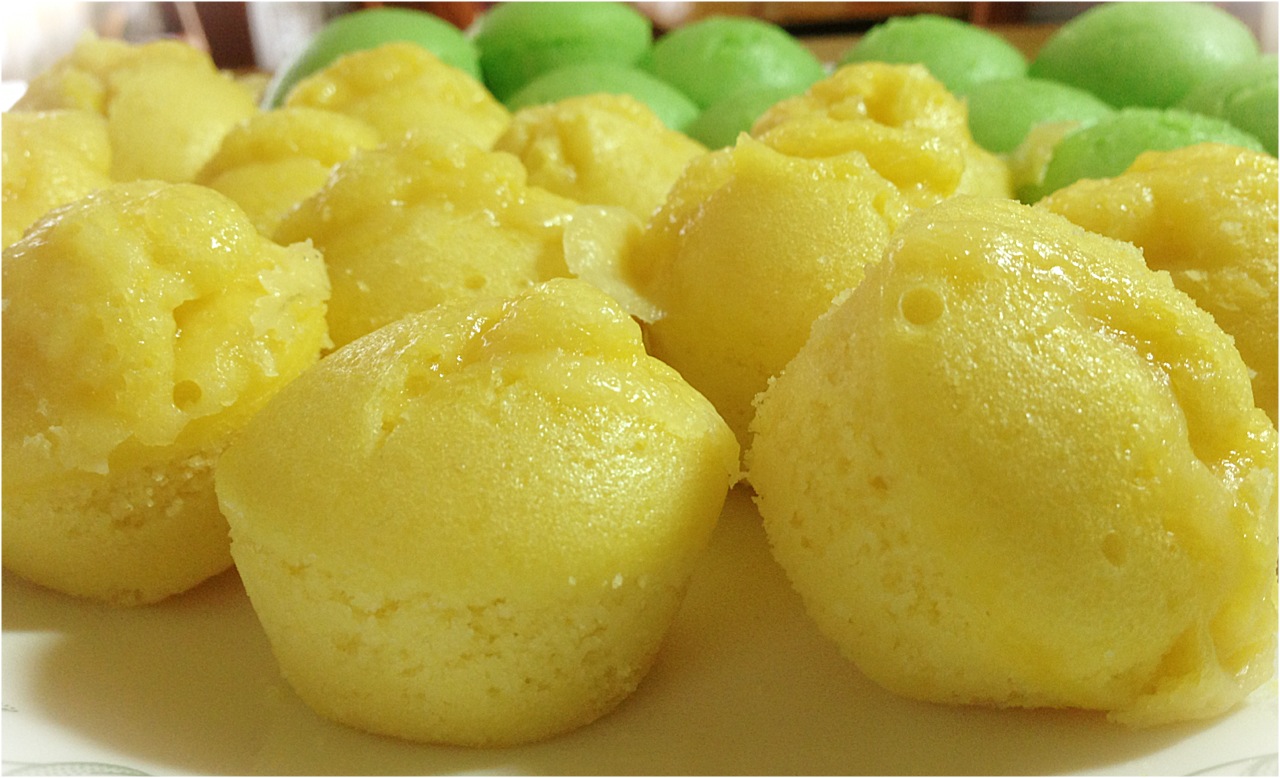
Here they are: my versions of the putong ube, muscovado, queso, and pandan.

Putong ube


Putong muscovado
Putong queso
Putong pandan
These puto were fluffy and moist, and most importantly, tasted like the flavour they were supposed to be.  So easy to eat a plateful in one go!  They were 'cake-y', fresh out of the steamer, which made me question whether this was the right texture or not.  My friend Mimi said that Michelle's puto was chiffon cake-like in softness and so my recipe must be on the right track.


Apart from the cracked top, I reckon these are pretty similar to Michelle's.  I wonder if the cracked top is meant to be their signature look?  My puto hardly had any cracks and am thinking of what I should do to get them (not that they look better with cracks).  Just asking.

Do you like steamed rice cakes?  Then stay tuned for the recipes.  Next time, I promise.

Monday, April 8, 2013

Ensaimada

You know how I recently bought an ice cream maker so I could make good use of leftover eggyolks?  Well, I have already made 6 ice cream flavours to date but only one actually had eggyolks in it.  Aside from discovering that ice cream can be as creamy and rich without eggs (thanks to this great book), I also want to say that my use of eggyolks has been wonderfully diverted elsewhere.

Ensaimadas.  I've mentioned these lovely buns in my last post. They have been a treat to make!  Tedious, yes, but the end result is more than gratifying.  I am even looking forward to those leftover eggyolks these days!

Fresh out of the oven.
Buttered, sprinkled with sugar, and topped with grated vintage cheddar cheese.
So fluffy and soft!
Wrapped just the way my aunts do it.
When I eat these ensaimadas, even for just a moment, I feel like I'm home.  Come to think of it, up until now, I've never eaten this outside the Philippines.  And it has always been my aunts' ensaimadas, no one else's ever!

"Home is where your heart is."  True?  I've been living in Australia for more than 12 years now and I have known all along where my heart really is.

For a great recipe and step by step tutorial on how to make ensaimada, head on over here.

Monday, March 25, 2013

Family and food

You know how it is said that "food brings people together"? So true.

When we went home to the Philippines, family members from both my husband's and my side went to great lengths to bring us food they knew we missed.  Everyday they would ask what else we wanted to eat (aside from what places we wanted to go to or what things we wanted to do).

Going back to Australia, I realized that we didn't really have to wait for many years till we can get to eat the same food again. I do know how to cook and we certainly have the resources here.

First thing I made was taho (warm silken tofu with brown sugar syrup and tapioca pearls).  We only had this once in my Dad's house as the street vendor didn't pass by regularly.  But growing up, this was a constant accompaniment to our breakfast. 

We've already made taho three times. My eldest son loves it.  If someone left even a bit on their cup, he would finish it off.  Even if it was cold. 


Next we thought of making hurricane popcorn.  This isn't Filipino food but my brother from Hawaii who was visiting the same time as us, gave us a box of this.  Definitely something different!  It's basically popcorn mixed with seasoned seaweed and rice crackers and flavoured with lots of butter.  

After we had finished all our hurricane popcorn packs, my daughter searched where we could buy them online.  Unfortunately, the only way was to order it from Hawaii. Next best thing of course was to just make it ourselves.  Easy and quite addicting!


Then there was ice buko with monggo (coconut ice pops with red mung beans).  We had this after my son's 19th birthday party.  On the way back to my Dad's house, we stopped by a small side street store to buy this. Making ice buko here at home was super great, especially since we had a terribly hot summer.


And then there was another refreshing dessert - buko pandan salad (creamy coconut pandan).  My youngest brother had this ready for us on our first night home!  Normally, this dessert isn't frozen (just chilled) but ever since a small Filipino family bakeshop (Nathaniel's) came out with a frozen version, that sort of became the standard to live up to.  Thus, I went the extra mile to make ours special as well.  I made my own vanilla ice cream to which I folded in the pandan jelly and young coconut cubes. Just as great, maybe even better!


I also experimented on making suman sa lihiya (sticky rice flavoured with lye water).  My mom used to order lots of these to give away every Christmas.  We would help arrange them in baskets then we would wrap the baskets in red or green cellophane all around.  

On our way to Tagaytay (south of Manila), we stopped by the eating places along the expressway to have breakfast and one of my brothers bought suman from one of the stalls outside McDonald's.  It was so yummy especially with the warm coconut jam sauce. My version wasn't as tasty though.  I think it's mainly because I used canned coconut cream instead of freshly squeezed and vacuum-packed banana leaves instead of newly-picked.  But hey, given my limited resources, it was certainly good enough.


Chocolate crinkles....we had these from the night we arrived till we left.  My husband's cousin even gave us hundreds of these to take back to Australia.  We just had to give away some or get sick of eating it.

All I can say, homemade is much better.


Last but certainly not the least, the ensaimada (Filipino version of a pastry/bread originally from Mallorca, Spain).  This is one food that my aunts never fail to bake for us.  Since I was a child, breakfast was always more special with this on the table.  They make the best ensaimada ever. Commercial ensaimadas definitely pale in comparison.  

With their recipe on hand, I finally tried to make ensaimada at home (after years of avoiding to).  Success on the first attempt!  I will be making these again for Easter Sunday.


So, do you agree that food brings people together?  To me, it is much, much more than that.  Making all this food didn't just satisfy my stomach but more importantly, they reminded me of the people I ate them with, the people I love the most.  And being reminded makes me happy each time.  It also makes me look forward to the next time I will get to be with them.  The food is just a sweet bonus.

As I am writing this, I'm thinking of what's the next thing to recreate....hmmmm.