Tuesday, August 5, 2014

Sans rival

Uninspired. 

That probably sums up how I've been feeling in the last month or so.  I believe the cause is a combination of plain burnout as well as emotional stress from having to deal with some personal issues lately.  Or maybe, just maybe, I am just nursing a hole in my heart after having watched 9 seasons of "The Office" straight and seeing it end :(.

For quite a while now, I have been thinking of making a sequel to my Frosted Heaven book.  I have actually already listed the chiffon cake varieties that I wanted to include in it but just the thought of having to make the cakes one by one so I can test them and take photos as well is making me feel sick already.  Can you believe that? Me, getting sick of chiffon?  For the time being, I'm afraid it's true so I have put this project on hold for now.

Last month, two of my kids had their birthdays.  No chiffon cake for us!  For my daughter's birthday on the 28th, I made a cookies and cream cheesecake.  She prefers cheesecake over cake anyway so, more than anything, this was a welcome change.  For my son's birthday a few days later (on the 31st), I made sans rival.  Believe it or not, although this is a Filipino favourite, it was my first time ever to make this dessert.


Since our oven is small and can only accommodate 2 baking trays at a time, I only made two meringue wafers which I each cut in half to make four layers.  The finished cake was only about 8"x6" but it was more than enough for the six of us.  As a matter of fact, it lasted for three days.  Not that it was not delicious.  It definitely was. However, being a really rich type of dessert, you can only eat it in little portions at a time.

Next time you feel like having something different (other than chiffon cake!), hope you can give this a try. Enjoy!

SANS RIVAL (makes a four-layered 8"x6" cake)

For the meringue wafers:

Ingredients:
1 cup eggwhites, room temperature
1/2 teaspoon cream of tartar
1 cup granulated white sugar
1 cup coarsely chopped unsalted roasted cashews **

**Although cashews are traditionally used, you can substitute this with other nuts such as almonds, pistachios, macadamias or whatever nut you prefer.

Preheat oven to 150C (300F).

Cut two pieces of baking paper about the same size as the underside of a large baking tray.  In the center of each, draw an 8"x12" rectangle.

Lightly grease the underside of two baking trays.  Stick each baking paper to a greased tray, drawn side down.  Just to make sure it would be easier to take off the baking paper later on, you can also grease the tops.


In a mixing bowl, combine eggwhites and cream of tartar.  Starting from a low speed gradually increasing to medium, beat until frothy.  Slowly add in sugar, then increase mixer speed to high and beat until eggwhites are stiff but not dry.

Gently fold in the chopped cashew nuts.


Divide the meringue equally between the two lined trays.  With an offset spatula, spread the meringue out using the drawn rectangle as a guide but go slightly past the lines.  Make it as level as you possibly can.


Bake meringue in preheated oven for about 1 1/2 to 2 hours, or until the meringue is dry, crisp and a light brown colour. (As I always say, since different ovens behave differently, baking time may vary.)  The important thing is that the wafers are crunchy - soft and soggy wafers are no good!


While still hot, use a long, sharp knife to carefully trim the sides of the meringue to make the edges straight (and aligned with the drawn rectangle on the baking paper). Cut each meringue in the center to make four 8"x6" pieces. Now that the pieces are smaller, they are easier to take off from the baking paper. Do this slowly. If you accidentally crack the meringue (like the lower right side of the meringue below), don't worry about it as you will be able to "repair" this with buttercream later.


For the French buttercream:

Ingredients:
1/2 cup granulated white sugar
1/4 cup water
2 eggyolks
1 whole egg **
1 cup butter, softened

**Typically, other recipes use all eggyolks.  This is just how my aunties made their version.  The whole egg makes the buttercream a tad lighter, I suppose. If you want all eggyolks, you can use a total of 5-6 instead.

In a small saucepan, mix together the sugar and water.  Bring to a boil over medium heat.  Clip a candy thermometer onto the side of the saucepan.  Once the temperature reaches about 90C (200F), start beating your eggs.


When syrup reaches 115C (240F), take it off the heat.  With mixer at low speed, slowly pour the hot syrup into the eggs. Aim for the area in between the mixer and the beaters.  If your syrup hits your beaters, it will splatter to the sides of the mixing bowl instead of combining with the eggs.


Beat the egg/syrup mixture until thick and light in colour. Set this aside in the fridge to cool.
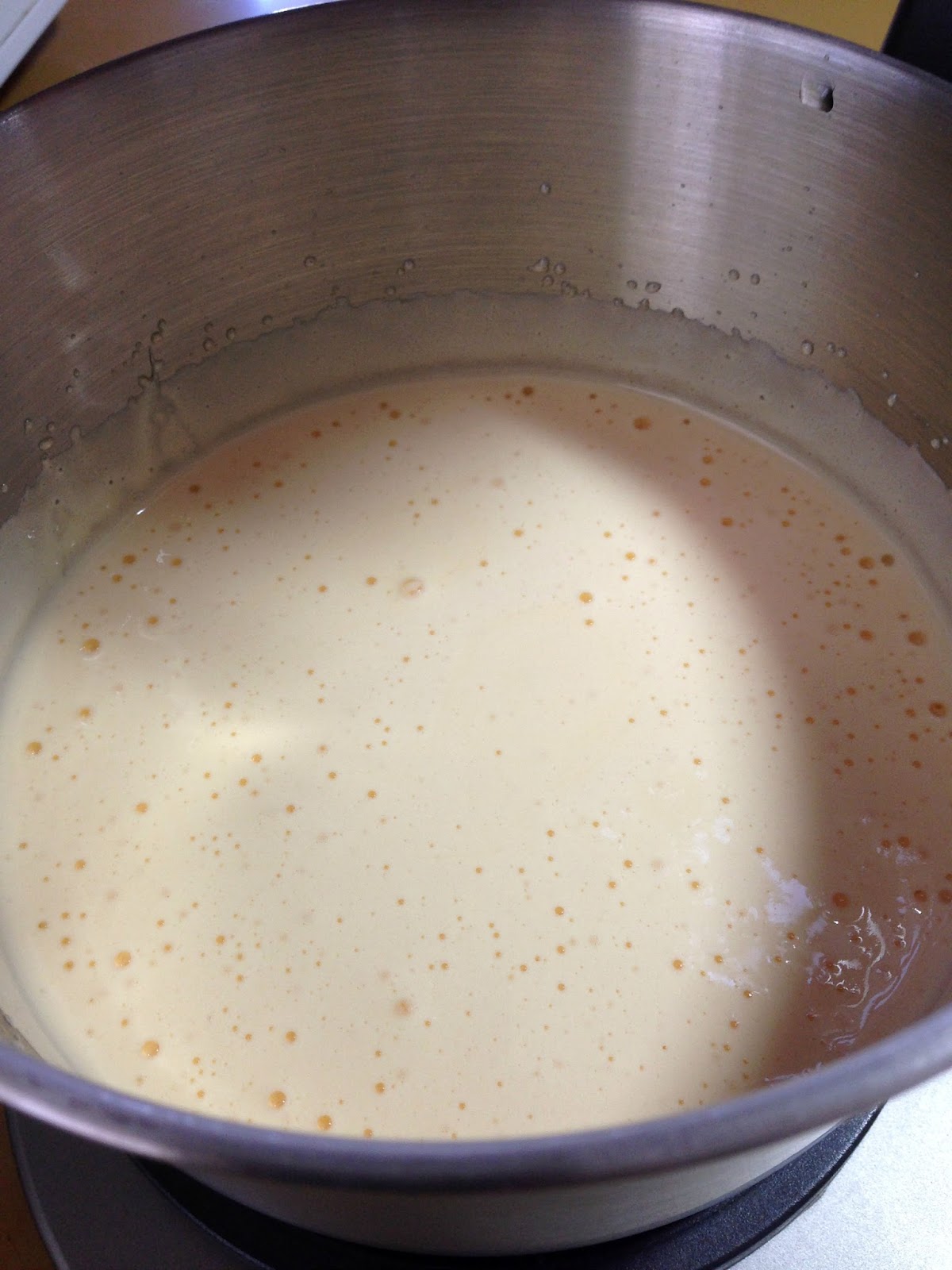

When cool, return bowl to the mixer, beat at medium speed while gradually adding in the soft butter.  Scrape down the sides to make sure all the butter is incorporated.


Once all the butter is in, increase mixer speed to high and beat until buttercream is light and fluffy.


To assemble Sans rival:

You will also need: 1 cup or more of coarsely chopped unsalted roasted cashew nuts (or whatever nut you used in the meringue).

On a cake board, alternate layers of meringue wafer and buttercream.  As the buttercream is very rich (and can become cloying if taken in large amounts), spread thinly only. If you have any cracked wafers, use a little buttercream to "glue" them together.  Cover the entire cake with the rest of the buttercream. 
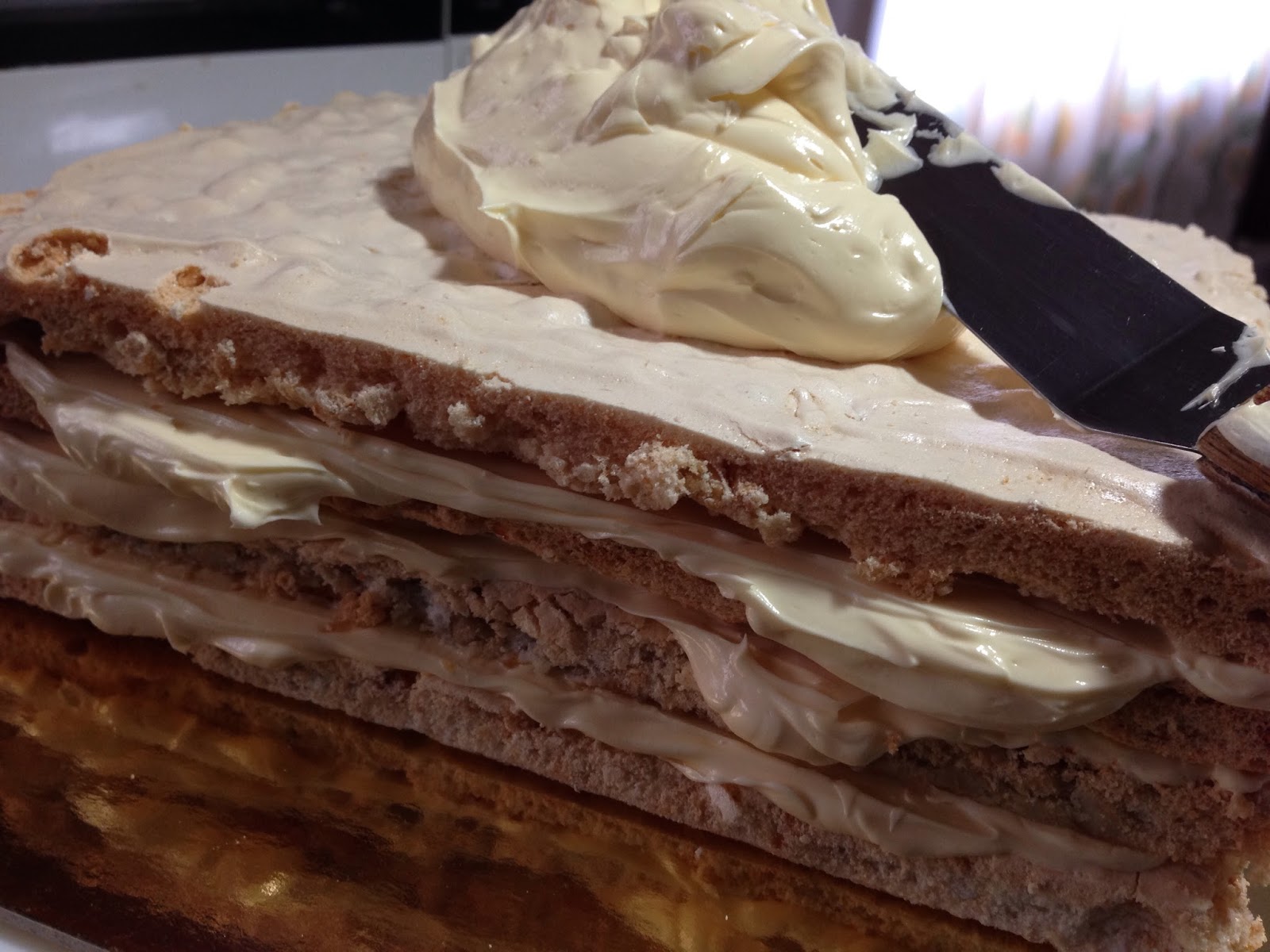

As with the cake pictured at the very top of this page, you can finish your sans rival off by piping borders (if you still have leftover buttercream) and by covering the top generously with chopped cashew nuts.  

Or if you absolutely love nuts, you can cover even the sides with more cashews!


Keep the sans rival in the freezer in a box or in an airtight container until time to serve to keep the meringue crunchy.  Use a very sharp knife to slice.


Remember to cut into small pieces only! 


Saturday, June 21, 2014

Vanilla Cupcakes Part 2 (with Maple Cream Cheese Frosting and Candied Bacon)

To the bacon lover, this cupcake is just another way to enjoy bacon.  To the non-bacon lover, this is an opportunity and/or a dare to be a little more adventurous!


The maple syrup and bacon combination is really nothing new.  However, having them both in a cupcake is not something you see everyday and can even be a repulsive idea to some. Come to think of it, this cupcake ticks all the boxes of good food - a medley of sweet, tangy, and salty, as well as a mix of different textures. Although I would not dream of eating this on a regular basis, for me, it was something I wanted to try even once.

To make these cupcakes, bake a batch of vanilla cupcakes using the recipe in the previous post or using your own favourite recipe.

To make candied bacon, you will need about 10-12 strips of streaky bacon.

1. Pre-heat your oven to 170 degrees C.  Line a baking tray with aluminium foil.
2. Place brown sugar on a plate.  Cover each bacon strip with brown sugar.


3.  Transfer bacon strips to your prepared baking tray.


4.  Bake for about 10-15 minutes on one side then flip them over and bake for another 10 minutes.  (The baking process might take longer depending on your oven and also on the thickness of your bacon.  What you want is for the bacon to be fairly crispy and golden brown.)


5.  Transfer bacon strips to a tray lined with baking paper and let cool completely.

6.  Chop bacon into small pieces.


To make the maple cream cheese frosting, follow the recipe here, substituting the vanilla extract with one tablespoon maple syrup.  Use to frost your vanilla cupcakes.

I used a large plain round  tip to pipe the frosting.

Top frosted cupcakes with a generous amount of candied bacon.


Now don't be scared to taste...just enjoy it!

Tuesday, June 17, 2014

Vanilla Cupcakes Part 1

Vanilla cupcakes are probably my least favourite of all cupcakes. However, in as much as I avoid making them, I believe that as a baker, it is an absolute must for me to have a delicious and foolproof vanilla cupcake recipe in my repertoire.  That and chocolate cupcakes at least.  I have tried many different recipes over the years, mostly from famous bakers and bakeries, but never was I completely happy with any of them.  Mostly, the cupcakes were too buttery and/or oily and were no good for more than a day. And almost always, no matter what recipe I used, after beautifully rising in the oven, the cupcakes sank after baking. So frustrating! Really an enigma how something supposedly so basic can be so hard to perfect.

I don't know why I didn't think of trying this before.  Yesterday, using the red velvet cupcake recipe that always gave me perfect cupcakes, I made a few adjustments and came up with my own vanilla cupcake recipe.  And what do you know, I baked my best batch ever!


The cupcakes were very light and tender (owing to the use of buttermilk), had a fine crumb, with just the right sweetness and vanilla flavour. They rose to a good height and did not sink at all :)))).  Definitely much better than any other vanilla cupcake I have ever made.

Sure, as always, I am happy to share this recipe! Before that though, let me just give you a quick insight on how I came up with the amounts of baking powder and baking soda.  For leavening, 1 1/2 teaspoons of baking powder or 1/4 teaspoon of baking soda is usually necessary for every cup of flour.  I did not use 100% baking powder as the recipe needed even a small amount of baking soda to neutralize the acid from the buttermilk.  With this in mind, I derived the proper amounts using simple math.  Clear enough?

On to the recipe.


VANILLA CUPCAKES (makes about 20)

Ingredients:
2 1/2 cups sifted cake flour
2 1/4 tsps baking powder
1/4 tsp baking soda
1/2 tsp salt
1/2 cup unsalted butter, softened
1 1/2 cups granulated white sugar
2 eggs, room temperature
2 teaspoons vanilla extract
1 cup buttermilk

Procedure:
1.  Preheat oven to 170 degrees C.  Line muffin trays with baking cups.
2.  In a medium bowl, sift together cake flour, baking powder, baking soda, and salt.  Whisk to combine.  Set aside.
3.  Using an electric mixer,  starting from a low speed gradually increasing to high, cream butter and sugar together until very light in colour and fluffy.
4.  With mixer turned down to medium-low speed, beat in eggs one at a time.  Add in vanilla extract.
5.  In three additions, alternately add in flour mixture and buttermilk, starting and ending with the flour mixture.  Scrape bowl as needed to ensure that everything is incorporated well.  After the last addition,
beat at high speed for the last time for about 45-60 seconds.
6.  Using a 2" ice cream scoop, fill each baking cup with the cupcake batter.
7.  Bake for about 22-25 minutes.  Transfer each cupcake immediately to a wire rack to cool completely.

How did I finish off these cupcakes?


Looks interesting to you? Wait for Part 2.

Wednesday, May 14, 2014

Flower pot cakes

I'm really sorry I didn't get to greet you mums out there on Mother's day.  I hope you all had a wonderful day and that you were truly spoiled by your loved ones! 

What extraordinary thing did your kids do for you? It's usually the girl(s) in the family who's the thoughful one, isn't it?  With boys, what can you really expect? My sons greeted me as soon as they woke up in the morning then off they went about their own business for the rest of the day.  My daughter, on the other hand, really went all out to make the day special for me.  She bought me flowers and sour lollies (which I love).  And she cooked for the family from breakfast till dinner!  She couldn't get the older boys to do anything but managed to "coerce" her (not so) little brother to somehow help her.

As for me, I made some flower pot cakes for a few of my mum friends.


I've been thinking about buying those silicone flower pots I've been seeing online lately but they seem to only come from the UK or US and are very, very expensive.  So instead, I went to our local home improvement store and bought real terracotta flower pots!  I bought twelve 9cm pots for only 74 cents each!

After cleaning with soap and hot water, I seasoned the pots by greasing each inside and out with oil, and then I put them in a 190 deg C oven for 30 minutes.  When they cooled, I repeated the process one more time. I read that seasoning seals the pores in the pot, prevents future cracking and somehow creates a non-stick surface for the pots as well.

Before baking, I greased and floured the pots first.  Then I filled them about 3/4 full with my chocolate cake batter. I baked the cakes at 180 deg C for about 40 minutes.  One cake was about 2 1/2 times bigger than a standard cupcake.


After they had cooled, I tapped the cakes out of the pots.  They cooked beautifully and came out really easily.  I trimmed the tops so I would have a level surface to put my frosting on, after which I placed them back in their pot.


I covered each cake top with chocolate frosting just enough to have a flat surface to pipe my flowers on.  I whipped up a batch of  Swiss meringue buttercream, made small portions of different colours, and then I was ready for the fun part!

First flower: chrysanthemum.  Used tip #81 for the petals, tip #3 for the center and tip #352 for the leaves.


Second flower: sunflower. Used tip#352 for both petals and leaves, tip#4 for the center.


Third flower: hydrangeas.  Used tip#103 for the petals, tip#3 for the dots, tip#352 for the leaves.


And lastly, roses. Used tip#104 for the petals, tip#352 for the leaves.


Here they are all together. Gorgeous, aren't they?


Sadly, I gave them all away!  I didn't leave even one for myself.

But that's ok.  I had a lot of fun and I know I made some friends pretty happy :).


PS.  I have a new recipe to share! It is for a really unique kind of cake. I'm just super busy till the end of this week but will do my best to do so really soon. Watch this space!

Tuesday, April 29, 2014

Leche Puto

**This post has been revised. 28/12/14

I feel somewhat like a sacrificial lamb.  Or maybe a guinea pig.

Because of my desire to share new recipes here, I experiment a lot.  If I'm lucky, I get it right the first time. But if I don't, I find myself measuring, and mixing, and baking, and adjusting ingredients over and over until I am completely satisfied.

It takes a toll on my body, you know. Taking in all those extra, unnecessary calories...sometimes to the point of feeling really sick. But it comes with the job, I guess.

I am happy though when I finally get it right.  And I know that I make a lot of other people happy too.

So, what is this so-called leche puto? Just from the name itself, one can deduce that it's a fusion of the Filipino steamed 'rice' cake (puto) and milk flan or creme caramel (leche flan).  It actually is, just sans the caramelized syrup. I did not know what this thing was until I watched this feature on a Filipino TV show.  The lady in the video said that the idea came about because she found that a lot of eggyolks were getting wasted in her puto-making as only the whites were needed.  It's as simple as that.  Brilliant, isn't it?  How people come up with these combinations? How something so simple can turn into a big business?

They showed the procedure on the video but understandably, not the recipe.  So I watched and watched and watched..and tried to figure it out.

First attempt - great flan, dense puto.  Second attempt - eggy flan, still dense puto.  Third attempt - overcooked flan, fluffy puto.

Four attempts later - a creamy flan, and soft and fluffy puto finally!


I don't know how many of these I had to pop in my mouth to come up with this recipe (I refuse to even think about it!).  So in saying that, I sure hope you all will appreciate and like it!  It will make the sacrifice more worth it!

LECHE PUTO (makes around 48 medium-sized pieces)

Ingredients:

For the flan:
4 egg yolks
1 can sweetened condensed milk (395g)
2 tsps lemon/calamansi juice or 1 tsp lemon extract

For the puto:
2 cups self-raising flour
1 1/2 tsps baking powder*
2/3 cup white granulated sugar
½ tsp salt
4 eggwhites (about 2/3 cup)
1¼ cups water
a few drops of yellow liquid food colouring (optional)

Procedure:

* I found that even if I am already using self-raising flour, I still needed to add a small amount of baking powder to make the puto fluffy.  I think this is because eggwhites toughen a cake and there are no eggyolks to make it more tender. Don't worry, there is no baking powder aftertaste!

**Note:  I used plastic puto moulds for this purpose.  You can use mini muffin pans but you will have to adjust the steaming time.  I tried using the pans in one of my batches and noticed that the flan cooked way faster.  You do not want to overcook it.  The flan should remain creamy yet firm enough to hold its shape.  When it's overcooked, it tastes like scrambled eggs (not good).

1.  Make the flan first.  In a small bowl, mix together the eggyolks and condensed milk.  Add in the lemon juice or extract.


Tip:  Get yourself these inexpensive plastic sauce dispensers.  It makes filling up the moulds so much easier and cleaner.

Use one for the flan mixture and one for the puto mixture.

2.  Heat water in bottom pan of steamer until water boils rapidly. Wrap steamer cover with a towel.

3.  Grease puto moulds then squirt the flan mixture into each mould, filling each about 1/3 full.


4.  Steam flan on LOW heat for about 5-7 minutes. At this point, the flan would not be fully set but should not be liquidy either.  Set aside to cool completely while you make the puto mixture.


5.  In a medium bowl, sift dry ingredients of the puto together.  Add in the wet ingredients and mix just until combined. Do not overmix.  Transfer mixture to your plastic dispenser.


6.  Prepare the steamer as before.  Top up with more water if needed and bring to a rapid boil again.

7.  Gently squirt puto mixture over flan, filling moulds nearly to the top.


8.  Steam the puto on LOW heat for another 10 minutes.  Remove from steamer and let cool slightly.


9.  To remove from moulds, carefully run a thin knife around the puto layer only.  Invert mould and tap to release the leche puto.

I think it is best to keep them inverted like this as the leche flan layer is more delicate and sticky.

Beautiful.  And I can assure you, it's absolutely delicious too.

Enjoy!


PS.  If you have any suggestions on what I should experiment on next, leave them on the comments section below.

Friday, April 11, 2014

Old fashioned butter icing

Back in 2011, when I was still trying to figure out how to make a caramel cake similar to Estrel's, I wasn't sure what kind of buttercream they were using.  The reason I chose Swiss Meringue buttercream was because I had leftover eggwhites from the caramel icing anyway so I might as well use them. I was convinced, however, that it wasn't IT.

Upon tasting the Estrel's famed caramel cake when I visited the Philippines last year, I observed two things about the butter icing - 1) it was salty; and 2) it had a "waxy" feel in the mouth.  It made me question if it was actually butter they were using.  Was it shortening perhaps?

Estrel's say they have not changed their recipe since they started in the 1940s.  In one article I read in their website, the owners mentioned what brand of milk and butter they have been using. To quote:

Quality ingredients more than make up half the success story. “We never changed the recipe, nor the way we did the butter roses and their shapes, sizes and colors of tinted peach, pink and green; nor the thickness and taste of the caramel icing. Before we used GI butter during Liberation. And at that time the best milk was imported Carnation full cream milk (has to be full cream, no dilutions). Now we use Alpine or Omela (from Thailand) full cream milk for the butter icing. And we have never substituted anything for Anchor butter ever since we started using it,” professed Mrs. Navarro.

Although they specifically said "full cream milk", the brands suggested they were actually evaporated and not whole milk.  From this little information, I think I now know how they make their butter icing.

Old fashioned cake = old fashioned recipe.  Why didn't I think of that before?  The recipe below is what my aunties iced and filled their sponge cakes and rolls with.  So simple and easy.

OLD FASHIONED BUTTER ICING

Ingredients:
1 cup butter, softened (I used salt-reduced.)
3/4 cup evaporated or whole milk **
3/4 cup granulated sugar
1 teaspoon vanilla extract (original recipe didn't have this)

**I have tried both types of milk and like whole milk better.

Procedure:
1.  Dissolve the sugar completely in the milk.  Set aside.


2.  In a mixing bowl, cream the butter until it is very light in colour. Start from the lowest speed then gradually increase to high.


3.  Turn down the mixer speed to low then gradually add in the milk/sugar mixture in thin streams.  Do this patiently, like 1 tablespoon at a time only. 


4.  When all the milk has been added, beat in the vanilla extract then increase the mixer speed to high and beat mixture until it is fluffy.

As all butter-based frostings are, the final colour is off-white.


This frosting seems soft but it is stiff enough that it will not fall off the spatula unless you really shake it off.


It spreads really smoothly too.


The taste? It's 100% buttery goodness! It does not only taste buttery but it appears buttery as well.  It actually feels like butter in the mouth!  (I don't know if that's actually a good thing or not!) How do you describe that? Waxy? Slippery? It's exactly how I remember the butter icing from Estrel's (though less salty since I didn't use regular salted butter.)  Definitely heavier in the mouth than Swiss meringue buttercream.

Now, let's test this thing on a caramel cake!

Lacy, squiggly lines, check. (Used piping tip #1 for that.)


More squiggly lines, check.


Borders, check. (Ruffle tip 88 and shell tip 18 for those.)


Roses, check! (Petal tip 124 for the roses, leaf tip 352 for the leaves.)


 Do I really think this is the sort of butter icing that Estrel's uses?

Looks pretty good to me!  The empty space is for some writing I had to add later on.

I am willing to bet on it!  Will I use it?  Definitely yes, for borders and flowers on a caramel cake.  However, to frost a whole cake with buttercream, I still prefer to use my favourite.  Still the winner for me in terms of texture and taste.

Try this butter icing next time you make a caramel cake and let me know what you think.

Have a good weekend!